 Intended as a textbook for electronic circuit analysis or a reference for practicing engineers, the book uses a self-study format with hundreds of worked examples to master difficult mathematic topics and circuit design issues. Computer programs using PSpice and MATLAB on the accompanying CD-ROM provide calculations and executables for visualizing and solving applications from industry. It covers the complex mathematical topics and concepts needed to understand and solve serious circuits problems.
 TABLE OF CONTENTS
 Network Analysis and Circuits
Chapter 2 - Kirchhoff's Laws And Their Applications
2.1 INTRODUCTION
Generally speaking, network analysis is any structured technique used to
mathematically analyze a circuit (a “network” of interconnected components).
This chapter presents a few techniques useful in analyzing such
complex circuits.
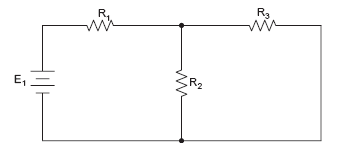
FIGURE 2.1
To analyze the above circuit, we would first find the equivalent of R2
and R3 in parallel, then add R1 in series to arrive at a total resistance. Then,
taking the voltage of battery E1 with the total circuit resistance, the total
current could be calculated through the use of Ohm’s law (I = E/R), then
that current figure is used to calculate voltage drops in the circuit. All in all,
a fairly simple procedure.
However, the addition of just one more battery could change all of that:
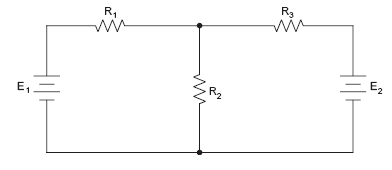
FIGURE 2.2
Resistors R2 and R3 are no longer in parallel with each other, because
E2 has been inserted into R3’s branch of the circuit. Upon closer inspection,
it appears there are no two resistors in this circuit directly in series or
parallel with each other. This is the crux of our problem: in series-parallel
analysis, we started off by identifying sets of resistors that were directly in
series or parallel with each other, and then reduced them to single, equivalent
resistances. If there are no resistors in a simple series or parallel configuration
with each other, then what can we do?
It should be clear that this seemingly simple circuit, with only three
resistors, is impossible to reduce as a combination of simple series and simple
parallel sections. It is something different altogether.
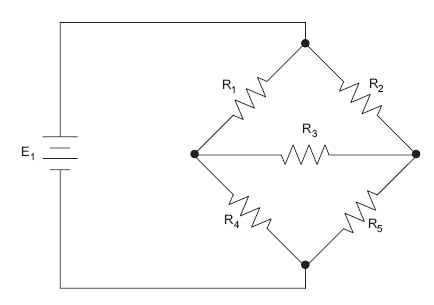
FIGURE 2.3
Here we have a bridge circuit, and for the sake of the example we will
suppose that it is not balanced (ratio R1/R4 not equal to ratio R2/R5). If
it were balanced, there would be zero current through R3, and it could
be approached as a series/parallel combination circuit (R1–R4 // R2–R5).
However, any current through R3 makes a series/parallel analysis impossible.
R1 is not in series with R4 because there’s another path for electrons to flow
through R3. Neither is R2 in series with R5 for the same reason. Likewise, R1
is not in parallel with R2 because R3 is separating their bottom leads. Neither
is R4 in parallel with R5.
Example 2.1. Find the value of current in resistance R3 shown in Figure 2.3,
where R1 = 1Ω, R2 = 2Ω, R4 = 3Ω, R5 = 6Ω, and R3 = 2Ω, E1 = 10 V.
Solution:

therefore, current flowing through R3 = 0 A (balanced bridge circuit).
Example 2.2.Find the value of current in R1 as shown in Figure 2.3. Other
parameters are the same as used in Example 2.1.
Ans. I = 2.5 A
Although it might not be apparent at this point, the heart of the problem
is the existence of multiple unknown quantities. At least in a series/parallel
combination circuit, there was a way to find total resistance and total voltage,
leaving total current as a single unknown value to calculate (and then that
current was used to satisfy previously unknown variables in the reduction
process until the entire circuit could be analyzed). With these problems,
more than one parameter (variable) is unknown at the most basic level of
circuit simplification.
With the two-battery circuit, there is no way to arrive at a value for “total
resistance,” because there are two sources of power to provide voltage and
current (we would need two “total” resistances in order to proceed with any
Ohm’s Law calculations). With the unbalanced bridge circuit, there is such a
thing as total resistance across the one battery (paving the way for a calculation
of total current), but that total current immediately splits up into unknown
proportions at each end of the bridge, so no further Ohm’s Law calculations
for voltage (E = IR) can be carried out.
So what can we do when we are faced with multiple unknowns in a
circuit? The answer is initially found in a mathematical process known as
simultaneous equations or systems of equations, whereby multiple unknown
variables are solved by relating them to each other in multiple equations. In
a scenario with only one unknown (such as every Ohm’s Law equation we
have dealt with thus far), there only needs to be a single equation to solve for
the single unknown.

However, when we are solving for multiple unknown values, we need to
have the same number of equations as we have unknowns in order to reach
a solution. There are several methods of solving simultaneous equations, all
rather intimidiating and all too complex for explanation in this chapter.
Later on we’ll see that some clever people have found tricks to avoid
having to use simultaneous equations on these types of circuits. We call
these tricks network theorems, and we will explore a few later in Chapter 8.

• Some circuit configurations (“networks”) cannot be solved by reduction
according to series/parallel circuit rules, due to multiple unknown values.
• Mathematical techniques to solve for multiple unknowns (called “simultaneous
equations” or “systems”) can be applied to basic laws of circuits
to solve networks.
© 2026 Infinity Science Press