 Intended as a textbook for electronic circuit analysis or a reference for practicing engineers, the book uses a self-study format with hundreds of worked examples to master difficult mathematic topics and circuit design issues. Computer programs using PSpice and MATLAB on the accompanying CD-ROM provide calculations and executables for visualizing and solving applications from industry. It covers the complex mathematical topics and concepts needed to understand and solve serious circuits problems.
 TABLE OF CONTENTS
 Network Analysis and Circuits
Chapter 10 - Two-Port Networks
10.1 INTRODUCTION
A pair of terminals at which a signal may enter or leave a network is called a
port and a network having only one such pair of terminals is called a one-port
network or simply a one-port. Similarly, a network having two ports, is known
as a two-port network. When more than one pair of terminals is present, the
network is known as a multi-port network.
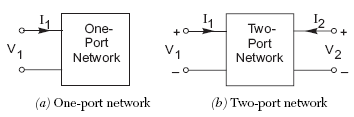
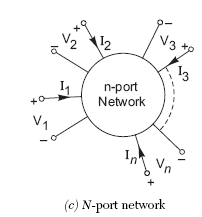
FIGURE 10.1 Different type of networks.
A general network having two pair of terminals, one as the input terminal
and the other as the output terminal, is a very important in various electrical
and electronics systems. In such a network an electrical signal enters the input
signal and leaves from the output terminals. Two ports containing no sources
in their branches are called passive ports. If there is any source (voltage or
current) in any branch they are called active ports.
A two-port network is shown in Figure 10.1(b). It has four variables (V1,
I1, V2, and I2). The first two variables (V1 and I1) are input variables and (V2
and I2) are output variables. Only two of the four variables are independent
and the other two are dependent. The dependence of two of the four variables
on the other two is described in a number of ways depending on which of the
variables are chosen to be the independent variables. There are six possible
sets of equations between V1, I1, V2, and I2.
TABLE 10.1 Two-Port Parameters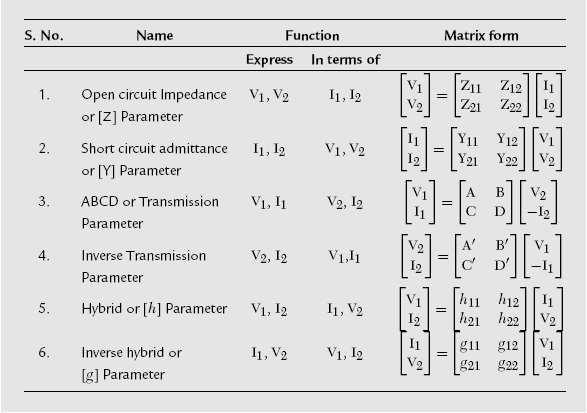
It is natural to ask why we need six different ways of evaluation and the
answer is two-fold. Firstly, some parameter sets are more easily measured
when their numerical values lie in a given range. Second, a particular problem
may be solved more easily in terms of one set than the others.
© 2026 Infinity Science Press