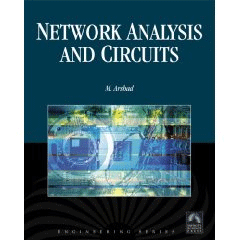
 Intended as a textbook for electronic circuit analysis or a reference for practicing engineers, the book uses a self-study format with hundreds of worked examples to master difficult mathematic topics and circuit design issues. Computer programs using PSpice and MATLAB on the accompanying CD-ROM provide calculations and executables for visualizing and solving applications from industry. It covers the complex mathematical topics and concepts needed to understand and solve serious circuits problems.
 TABLE OF CONTENTS
 Network Analysis and Circuits
Chapter 12.13 Selectivity And Bandwidth Of A Parallel-Tuned Circuit
12.13 SELECTIVITY AND BANDWIDTH OF A
PARALLEL-TUNED CIRCUIT
Figure 12.19(a) shows a voltage source V of width impedance Rg driving the
parallel-tuned circuit. Figure 12.19(b) shows an equivalent circuit in which
the voltage generator has been replaced by the equivalent current generator
by using the source transformation method.

FIGURE 12.19 A parallel-tuned circuit driven from a voltage source and its equivalent
circuit.
We proceed to find the selectivity and bandwidth of the parallel circuit
neglecting the source resistance Rg. Under this condition, a constant current
I flows through the parallel circuit and the output voltage across the parallel
circuit is given by

Current I being constant, the output voltage V0 varies exactly in the same
fashion as the impedance Z of the parallel circuit. The response of the parallel
circuit, i.e., the output voltage V0, is maximum at resonance and falls off on
either side in accordance with the curve of Figure 12.18.
At the half-power frequencies f1 and f2, the impedance Z falls to a value  . Hence, from Equation (12.82)

or

or

At upper half-power frequency f2,

At lower half-power frequency f1,

Hence,

or

This Qr is a measure of the selectivity of the parallel resonant circuit.
The higher the value of Qr the more selective the circuit. Qr may also
be put as

QUESTIONS FOR DISCUSSION
- What is resonance ?
- What is the difference between series and parallel resonance ?
- What do you mean by current resonance ?
- What is resonant frequency ?
- What is the value of the power factor at resonance ?
- What is the phase difference between voltage and current at
resonance ? - What is bandwidth ?
- What is the relation between time period and frequency ?
- What is quality factor ?
OBJECTIVE QUESTIONS


UNSOLVED PROBLEMS
- Two impedances Z1 = a + Jb and Z2 = c − Jd are connected in (a)
series and (b) parallel. Determine the condition of resonance in each
case. - A coil has impedance (2 + 2J) connected in series with the capacitor
10μF. Determine the frequency at which resonance occurs and also
determine the Q-factor. - A series RLC circuit consists of resistance R = 10Ω, L = 0.05 H, and
C = 0.02μF. Calculate the resonant frequency. Also determine the
frequencies at which the voltage across the capacitor and inductor are
maximum (individually). - Prove for series RLC circuit the value of the current is maximum.
- Prove for series resonant circuit Bw =
 where Bw = Bandwidth.
 - Two impedances Z1 = 2 + Jb and Z2 = C + 3J are connected in
parallel. Determine the condition of resonance.
© 2026 Infinity Science Press