
Flange Mechanical Clutches
Description
Flange mechanical clutches are devices used to connect and disconnect two rotating shafts. They are mounted to the object in motion via a flange, which provides a secure and stable connection point. This type of clutch is designed to transmit torque between the shafts, allowing for controlled engagement and disengagement of power.
Working Principle
Flange mechanical clutches operate by engaging and disengaging the connection between two rotating shafts. The flange serves as the mounting point, ensuring that the clutch is securely attached to the object in motion. The engagement can be achieved through various methods, such as friction, where contact surfaces transmit power, or through non-contact technologies like magnetic fields. These clutches are useful because they allow for precise control over the transmission of power, enabling smooth operation and protection of machinery from overloads.
Applications
Flange mechanical clutches are used in a variety of applications where controlled engagement and disengagement of power are required. Specific examples include production equipment such as conveyors, bottle capping machines, and textile processing equipment. They are also found in transportation and off-road vehicles, where regular disengaging and engaging of gears, pulleys, belts, and chains are necessary.
Advantages over other Mechanical Clutches
Flange mechanical clutches offer several advantages over other types of mechanical clutches. For instance, their secure mounting via a flange provides stability and reliability in high-torque applications. Additionally, the ability to use different engagement methods, such as friction or magnetic fields, allows for customization based on specific operational needs, enhancing their versatility and effectiveness in various industrial settings.
Limitations
One limitation of flange mechanical clutches is that they may require precise alignment during installation to ensure optimal performance. Misalignment can lead to increased wear and tear, reducing the clutch's lifespan. Additionally, depending on the engagement method used, there may be limitations in terms of speed and torque capacity, which could restrict their use in certain high-demand applications.
Considerations
When selecting a flange mechanical clutch, several factors should be considered. Initial costs can vary based on the complexity and type of engagement method chosen. Operating expenses may include energy consumption, especially for electromagnetic or pneumatic clutches. Durability is influenced by the materials used and the operating environment, while accuracy in engagement and disengagement is crucial for maintaining system performance. Replacement and maintenance costs should also be factored in, as regular servicing may be required to ensure longevity and reliability.
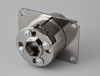
from TOK America, Inc.
SR12 series is a high torque clutch that can move your equipment and products smoothly and stop heavy objects at any position. This can handle high torque but can be installed with less space. [See More]
- Mounting: Flange
- Shaft: In-line
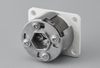
from TOK America, Inc.
TOK has developed a new type of uni-directional clutch, named the SR2. The SR2 provides controlled motion to adjust height at any position. Through its inverse interrupting mechanism, this breakthrough technique conducts driving from the input shaft to the output shaft, and locks the input in place... [See More]
- Mounting: Flange
- Shaft: In-line
- Torque: 0.9
- Diameter: 1.42
from GMN Bearing, USA Ltd.
Free-wheel clutch, roller ramp technology [See More]
- Mounting: Through; Flange
- Special: Freewheeling
- Torque: 11.0
- Engagement: Roller Ramp