
Toothed Mechanical Clutches
Description
Toothed mechanical clutches are devices designed to transmit power between two rotating shafts without slipping. They achieve this by using toothed contact surfaces that interlock, ensuring a secure and precise transmission of torque.
Working Principle
Toothed mechanical clutches operate by engaging toothed surfaces that mesh together to transmit torque. This engagement is typically achieved when the device is either stopped or running at a slow speed, usually less than 20 rpm. The interlocking teeth provide a positive drive, which means there is no slippage between the input and output shafts. This characteristic makes them particularly useful in applications where precise torque transmission is critical, as they ensure that the power is transmitted efficiently and accurately without generating heat.
Applications
Toothed mechanical clutches are commonly used in applications that require precise control of torque transmission. Specific examples include production equipment such as conveyors, bottle capping machines, and textile processing equipment. They are also found in transportation and off-road vehicles, where regular engagement and disengagement of gears, pulleys, belts, and chains are necessary.
Advantages over other Mechanical Clutches
One of the primary advantages of toothed mechanical clutches over other types is their ability to transmit power without slipping. This ensures a high level of accuracy and efficiency in torque transmission. Unlike friction-based clutches, toothed clutches do not generate heat during operation, which can be beneficial in applications where temperature control is critical.
Limitations
A notable limitation of toothed mechanical clutches is that they can only be engaged when the device is stopped or running at a slow speed. This restriction can limit their use in applications that require engagement at higher speeds. Additionally, the precise alignment required for the teeth to mesh correctly can be a challenge in some setups.
Considerations
When considering the use of toothed mechanical clutches, several factors should be taken into account:
- Initial Costs: The precise manufacturing required for toothed surfaces can result in higher initial costs compared to simpler clutch designs.
- Operating Expense: While they do not generate heat, which can reduce cooling costs, the need for precise alignment and potential wear on the teeth may increase maintenance expenses.
- Durability: Toothed clutches are generally durable due to their robust design, but the interlocking teeth can wear over time, especially if not properly aligned.
- Accuracy: These clutches provide high accuracy in torque transmission, making them suitable for applications where precision is paramount.
- Replacement and Maintenance Costs: Regular inspection and maintenance are necessary to ensure the teeth remain in good condition and properly aligned, which can add to the overall cost of ownership.
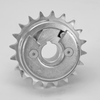
from Lowell Corporation
Lowell Corporation One Way Sprocket for original equipment manufacturers and plant operation. One Way Roller Clutches, One Way Sprocket Clutches. Economical to buy, easy to apply, simple to use. Pick the size of the sprocket needed and we ’ll build it into an assembly. Or substitute a pulley,... [See More]
- Engagement: Toothed
- Mounting: Shaft
- Shaft: In-line
- Bore Diameter: 0.5620 to 1.25

from Andantex USA, Inc.
Overview. These clutches are used wherever different sections of a machine needs to be first disengaged from the drive train then re-engaged while maintaining the same phase or angular relationship which existed prior to disengagement. They are often used in a line-shaft, between printing units on... [See More]
- Engagement: Toothed
- Power: 110
- Torque: 222.0
- Rotary Speed: 2700