
Switch / Relay Output Pressure Controllers
Description
Switch/Relay Output Pressure Controllers are devices designed to regulate pressure by receiving inputs from pressure sensors and providing control functions. They output control signals to manage the pressure within a system, ensuring it remains within specified limits.
Working Principle
Switch/Relay Output Pressure Controllers operate by using pressure sensors to monitor the pressure levels within a system. When the pressure reaches a predetermined set point, the controller activates a relay to either increase or decrease the pressure, maintaining it within the desired range. This functionality is crucial as it provides automatic supervision and control of pressurized fluid systems, enhancing safety and reducing the need for constant human monitoring. These controllers can utilize various control strategies, including proportional, integral, and derivative (PID) control, which allows for precise and stable pressure regulation .
Applications
Switch/Relay Output Pressure Controllers are widely used in various industrial applications. For example, in wellhead pressure interlock protection, these controllers are used to shut down operations if the pressure exceeds or falls below a set range, ensuring safety in onshore applications . They are also integral to automated systems in manufacturing, where they provide cost-effective control and supervision of pressurized fluid systems .
Advantages over other Pressure Controllers
One of the key advantages of Switch/Relay Output Pressure Controllers is their ability to provide automatic control without the need for costly computing systems. This makes them a cost-effective solution for many industrial applications. Additionally, their ability to integrate with programmable logic controllers (PLCs) and distributed control systems (DCSs) enhances their versatility and functionality .
Limitations
A notable limitation of these controllers is their susceptibility to drift, which is the gradual degradation in the accuracy of readings over time. This can occur due to wear from frequent use, affecting the reliability of the pressure control .
Considerations
When selecting a Switch/Relay Output Pressure Controller, several factors should be considered. Initial costs can vary depending on the complexity and features of the controller. Operating expenses may include maintenance and calibration to address issues like drift. Durability is an important factor, as these devices are often used in rugged industrial environments. Accuracy is crucial for maintaining system stability, and replacement and maintenance costs should be factored into the overall cost of ownership. Additionally, the pressure range and set point options should be carefully selected to match the specific requirements of the application .
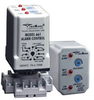
from Time Mark Corporation
The Model 661 Alarm Control, part of the 600 series line of instrumentation controls, is designed to monitor and maintain measurable applications such as liquid levels, temperature, pressure, flow, etc. A user-provided 4-20mA current loop represents the measurable application, and output connections... [See More]
- Control Signal: Switched Output
- Features: Rate Indication/ Control
- Control: Limit
- Type: Current Loop (Transmitter) Excitation

from Florite International, Inc.
The 900 Series is an economic one loop microcomputer-based instrument incorporating user selectable digital and analog inputs, as well as analog and relay outputs. Other 900 Series features include .005% high accuracy PID, batch, and dose control functions. Additionally, the 900 Series encompasses... [See More]
- Control Signal: Analog Voltage Output; Current Loop Output; Switched Output; Serial / Digital; Network / Fieldbus Output; Screw Terminal
- Control: Limit; Linear; Feedforward; PID
- Controller Type: Laboratory
- Features: PLC; Multi-Function; Datalogger; Is a Chart Recorder; Rate Indication/ Control; Totalizing (Length or Roll Diameter) Indication/ Control

from Barksdale Control Products
Barksdale's UAS3 Electronic Trip Amplifier and controller is the perfect companion to any sensing device that provides a 4-20 mA or 0-10 VDC analog output. Our UAS3 offers the unique ability to switch four discrete circuits in a single, compact unit. In addition to its four SPDT relays, the UAS3... [See More]
- Control Signal: Analog Voltage Output (optional feature); Current Loop Output (optional feature); Switched Output
- Interface: Digital Front Panel
- Control: Limit
- Inputs: 1

from Gefran
Single-loop microprocessor controller, 96 x 96 (1/4 DIN) format, appropriate for processes with high variation speed. Thanks to its extended functions and configurable hardware and software, it provides high applicative flexibility in systems that control and monitor pressure, force, temperature,... [See More]
- Control Signal: Analog Voltage Output; Current Loop Output; Switched Output
- Control: Limit; PID
- Controller Type: Ratio Controller
- Form Factor: DIN
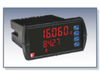
from PMC Engineering LLC
The DPM is a multipurpose, easy to use digital dual-input process meter ideal for level, flow rate, temperature transmitter, or pressure transmitter applications. Various math functions may be applied to the inputs including addition, difference, absolute difference, average, weighted average,... [See More]
- Control Signal: Switched Output; Network / Fieldbus Output; Modbus RTU Communication
- Features: Multi-Function; Datalogger; Rate Indication/ Control; Totalizing (Length or Roll Diameter) Indication/ Control
- Control: Limit
- Form Factor: Chassis