
Mass Spectroscopy Detector High Performance Liquid Chromatographs (HPLC)
Description
Mass Spectroscopy Detector High Performance Liquid Chromatographs (HPLC) are sophisticated analytical instruments used to separate, identify, and quantify components in a mixture. These devices utilize mass spectroscopy as a detection method, which involves ionizing a sample and using a mass analyzer to detect the ion current. This allows for the detailed analysis of the molecular composition of the sample.
Working Principle
The working principle of Mass Spectroscopy Detector HPLC involves several key steps. Initially, the sample is introduced into the HPLC system, where it is separated into its constituent components as it passes through a chromatographic column. Once separated, the components enter the mass spectrometer, where they are ionized. The mass analyzer then separates these ions based on their mass-to-charge ratio (m/z), allowing for the detection and analysis of the sample's molecular structure. This technique is particularly useful due to its high sensitivity and specificity, enabling the detection of even trace amounts of substances.
Applications
Mass Spectroscopy Detector HPLC is widely used in various fields for specific applications. In the food industry, it is employed for the qualitative and quantitative analysis of food content, including the detection of vitamin C, food additives, contaminants, and spoilage. This technique is also crucial in environmental analysis, where it is used to detect trace organic pollutants. Additionally, it plays a significant role in the analysis of pesticides and herbicides.
Advantages over other High Performance Liquid Chromatographs (HPLC)
One of the primary advantages of using Mass Spectroscopy Detector HPLC over other types of HPLC is its increased sensitivity and specificity. The mass spectrometer's ability to provide detailed structural information and identify unknown compounds through characteristic fragmentation patterns makes it superior in applications requiring precise molecular analysis. Furthermore, the combination of HPLC with mass spectrometry enhances the accuracy and depth of information obtained, which is particularly beneficial in complex mixture analysis.
Limitations
Despite its advantages, Mass Spectroscopy Detector HPLC has certain limitations. It may struggle to distinguish between optical and geometrical isomers and the positions of substituents in aromatic rings. Additionally, its scope is limited in identifying hydrocarbons that produce similar fragmented ions. These limitations can affect the accuracy of the analysis in specific scenarios.
Considerations
When considering the use of Mass Spectroscopy Detector HPLC, several factors should be taken into account. The initial cost of these instruments can be high, and they require significant investment in terms of operating expenses, including maintenance and replacement parts. The durability and accuracy of the system are critical for reliable results, and regular calibration and maintenance are necessary to ensure optimal performance. Additionally, the complexity of the system may require specialized training for operators to effectively manage and interpret the data generated.
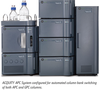
from Waters Corporation
The Next Era in Polymer Separation. Highest-resolution, size-based separations for chromatographic polymer characterization. Improve data consistency and quality by enabling fast, daily calibration. Automate method development with advanced system technologies. Get more information about your... [See More]
- Detector Type: Mass Spectroscopy
- Analysis Method: Analytical
- Instrument Type: Fixtured
- Remote Interface: Computer Interface

from Shimadzu Scientific Instruments, Inc.
Shimadzu's Discovery VP Analytical System enables characterization of microgram to milligram quantities of lead candidates generated from Drug Discovery, Medicinal Chemistry, Natural Product Isolation, or Organic Synthesis efforts. Up to ten columns and four solvent pairs can be configured, making... [See More]
- Detector Type: Ultraviolet/Visible Light Detector; Refractive Index; Light Scattering; Mass Spectroscopy; PDA
- Analysis Method: Analytical
- Instrument Type: Fixtured
- Injection Method: Auto-sampler Injection

from Hitachi High-Tech America
Outstanding Performance. Two performance capabilities supporting data reliability: excellent reproducibility made possible by the pump and autosampler and excellent stability of the column oven and detector. Easy-to-use. Along with simple operation and ease of use, Chromaster offers ease of... [See More]
- Detector Type: Ultraviolet/Visible Light Detector; Refractive Index; Fluorescence; Mass Spectroscopy
- Analysis Method: Analytical
- Instrument Type: Fixtured
- Injection Method: Auto-sampler Injection

from Waters Corporation
Monitor protein conformation with HDX technology. The ACQUITY UPLC ® M-Class System with HDX Technology leverages UPLC ® separations and high-resolution MS to answer important questions about changes in protein conformation including: Drug candidate binding to a protein. Biopharmaceutical... [See More]
- Detector Type: Mass Spectroscopy
- Analysis Method: Analytical
- Instrument Type: Fixtured
- Maximum Pump Pressure: 15000

from Shimadzu Scientific Instruments, Inc.
To speed up R &D in such areas as pharmacokinetics (drug manufacturing), it has become increasingly necessary to analyze large numbers of samples at high speed and high precision. In response to these demands, the new Nexera MP Ultra High Performance Liquid Chromatograph utilizing the SIL-30ACMP... [See More]
- Detector Type: Mass Spectroscopy
- Analysis Method: Analytical
- Instrument Type: Fixtured
- Injection Method: Auto-sampler Injection