
Frame Relay Network Test Equipment
from Spirent Communications
Designed to fit into the Spirent SMB-200/2000 chassis [See More]
- Network Protocol: ATM; Frame Relay; PPP
- Number of Ports: 1
- Equipment Type: Network / LAN Analyzer
- Form Factor: Computer Board

from GL Communications, Inc.
Frame Relay is commonly used data link protocol based on packet switching technology. It is mainly incorporated by the corporate data networks due to its cost-effective data transmission, and flexible bandwidth. Frame relay is mostly used to connect local area networks with major backbones; also... [See More]
- Network Protocol: Frame Relay
- Equipment Type: Protocol Analyzer

from Patton Electronics Co.
When the BERT is testing a synchronous device, a CCITT 511 pattern is transmitted. The BERT receiver verifies that the returning data is error-free, at which point the LED is lit.When in async mode, the BERT sends QUICK BROWN FOX messages and waits to receive the FOX messages back before... [See More]
- Network Protocol: Frame Relay
- Form Factor: In-Line
- Equipment Type: Bit-Error Rate Testers
- Port Type: RS232; V.24
from GL Communications, Inc.
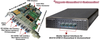
Voice, data, and video traffic is exploding as smartphones, IP TV, video streaming, and "cloud" based services takeoff. A majority of the backbone transport for these applications continues to be SONET and SDH optical transmission networks. A dominant protocol for IP transport is PoS (Packet over... [See More]
- Network Protocol: ATM; Frame Relay; E1; ISDN; PPP; T1; HDLC, MLPPP, GSM, TRAU, GPRS, UMTS, SS7, CAS, SS1, SSM, V5.x, DCME, FDL
- Form Factor: Computer Board
- Number of Ports: 5

from GL Communications, Inc.
Multi-Link Frame Relay, or MFR, is similar to Multi-Link PPP, and both are a form of inverse multiplexing. Users rely on inverse multiplexing when access line capacity does not scale smoothly, i.e. notice the big jumps in bandwidth from 56kbps, 1.544 Mbps, and 45 Mbps. In such cases, intermediate... [See More]
- Network Protocol: Frame Relay