Pipeline Rules of Thumb Handbook: Quick and Accurate Solutions to Your Everyday Pipeline Problems, Sixth Edition

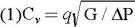
Volume basis:
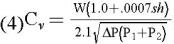
Weight basis:
Equation 1 and Equation 2 exclude control valve calculations where flashing, high-viscosity, two-phase flow, or high pressure drops are involved.
Volume basis:
Equation 3 does not take into consideration gas compressibility, mixed phase flow or high pressure drop. Compressibility is considered in Equation 12 and Equation 13. Usable pressure drop for valve sizing calculations for gas, vapor, and steam flows is always limited to of the absolute inlet pressure of the control valve. At that approximate value, critical (sonic) velocity is reached and any further reduction of the downstream pressure will not increase the velocity through a valve, thus there will be no increase in flow.
Equations are given below to correct for flashing, cavitation, high-viscosity fluids, and mixed phase flow, where the simplified equations may lead to inaccurate sizing. These additional expressions, together with the FCI equations, provide satisfactory solutions for most control valve sizing applications.
Flashing service. When flashing occurs, the simplified liquid sizing equation gives erroneous results. Flashing occurs when liquids enter a valve at or near their boiling points, and they begin vaporizing as their pressures decrease, due to conversions of static pressure head to velocity head. With the advent of high recovery valves, this condition has been aggravated. High recovery valves take a much higher pressure drop from inlet to valve orifice than standard control valves (see Figure 1).