Hand-Held Computer Determines Concrete Coating Thickness
Technical data for the engineer's file
Frank E. Hangs, Sovereign Engineering, Inc., Houston
Pipeline crossings, under water or in unstable soil, offer many challenges to engineers.
Pipe is buoyant, and an empty line may float in water. Wet silts are like viscous fluids causing inadequately weighted pipelines to pop up. There are various government entities that have jurisdiction over navigable rivers, bays, marshlands, and offshore waters. These agencies may stipulate that pipelines be buried at certain depths and be stabilized.
A good way to stabilize a pipeline is to use an adequate concrete weight coating. Determining the thickness of the concrete involves a process of balancing upward forces such as buoyancy of the mud and the downward forces weights of pipe, protective coating, and concrete, allowing a factor of 60 (negative buoyancy). Such computations with several variables can become involved and tedious.
Computer program
The following program, written for the Hewlett Packard 41CV (Figure 1), calculates the thickness of concrete weight coating for submarine pipelines expeditiously and with satisfying results.
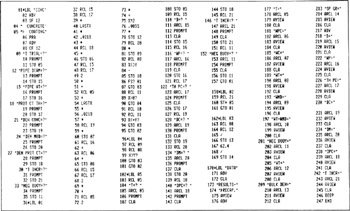 Figure 1: Hewlett Packard-41CV computer program
 The prompting feature (Figure 2) is employed to aid users' data input. Important calculated values and a recap of the inputs are printed out, and each quantity is identified. Thus, the tape is a complete record. The program is flexible in that any inputs can be readily changed for a second run. Thus, many "what if" questions can be answered quickly. Suppose a heavier-weight pipe is used?


 TABLE OF CONTENTS