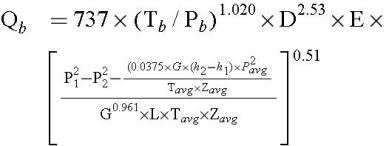
Nomenclature for Panhandle Equations
Qb = Flow rate, SCFD
Pb = - Base pressure, psia
Tb = Base temperature, R
T avg = Average gas termperature, R
P 1 Inlet pressure, psia
P 2 Outlet pressure, psia
G = Gas specific gravity (air = 1.0)
L = Line length, miles
Z = Average gas compressibility
D = Pipe inside diameter, in.
h 2 = Elevation at terminus of line, ft
h 1 = Elevation at origin of line, ft
P avg = Average line pressure, psia
E = Efficiency factor
E = 1 for new pipe with no bends, fittings, or pipe diameter changes.
E = 0.95 for very good operating conditions, typically through first 12-28 months
E = 0.92 for average operating conditions
E = 0.85 for unfavorable operating conditions
Nomenclature for Weymouth Equation
Q = Flow rate, SCFD
Tb = Base temperature, R
Pb = Base pressure, psia
G = Gas specific gravity (air = l)
L = Line length, miles
T = Gas temperature, R
Z = Gas compressibility factor
D = Pipe inside diameter, in.
E = Efficiency factor. (See Panhandle nomenclature for suggested efficiency factors


 TABLE OF CONTENTS