Pipeline Rules of Thumb Handbook: Quick and Accurate Solutions to Your Everyday Pipeline Problems, Sixth Edition

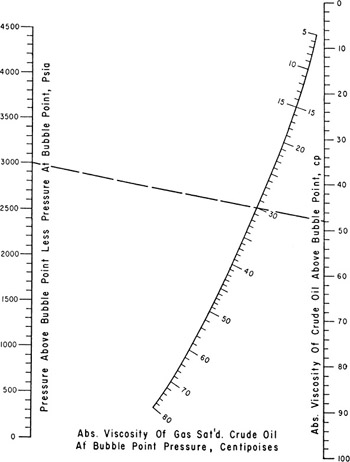
If the viscosity of a gas-saturated crude oil at the saturation (bubble-point) pressure is known, using this homograph you can quickly estimate the viscosities at higher pressures.
Find the viscosity at 4,200 psia for a crude oil when its viscosity is 30 cp at the saturation pressure of 1,200 psia. Notice that 4,200 psia is 3,000 psi above the saturation pressure. Connecting 3,000 on the pressure difference scale (left) with 30 on the curved scale for viscosity at the bubble-point pressure, the intersection with the scale on the right at 48 cp is the desired value.

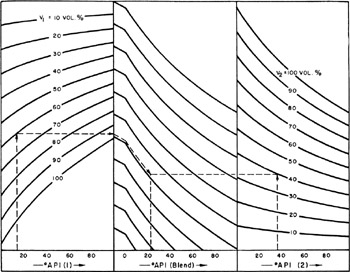
API gravity of a crude oil blend may be readily estimated from the gravity of the components and their percentage composition. It is a simple procedure to use these curves to find the resulting API gravity of the blend.
If you blend a 14 API pitch (60%) with a 36 API cutting stock (40%), the resulting fuel oil has an API gravity of 22 as read from the nomograph. Calculated result from gravity tables would be 22.1 API.
Results found using this nomograph checked out within 1 API over the range of gravities and percentage of components (1) and (2) in the nomograph below. Estimates from the nomograph are based on the assumption that volumes of blends are additive and that no light components flash off in blending.

This line chart provides an easy method for converting...