Pipeline Rules of Thumb Handbook: Quick and Accurate Solutions to Your Everyday Pipeline Problems, Sixth Edition

This section presents data on how to calculate the length of hose, and pressure loss, through marine hose.
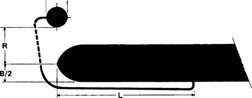
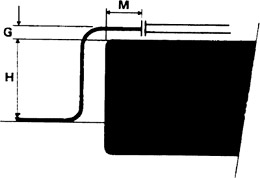
The overall length of the floating hose string is designed as follows:
where:
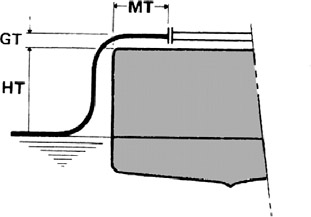
TL = Required overall length
C = Diameter of buoy
R = Length of mooring hawser
E = Max. elongation of mooring hawser
B = Beam of tanker
L = Distance between bow and manifold
H = Maximum (light ballast) freeboard (approx. 0.8 tanker depth)
M = Distance between rail and manifold
G = Height of manifold from deck


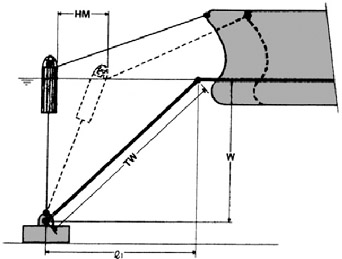
The required overall length of hose string is designed as follows:
where:
? = Distance between hose arm [*] and floating hose
R = Length of mooring hawser
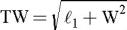
TW = ??+W 2
W = Maximum water depth at hose arm [*]
where:
TL = Required overall length of hose string
HM = Max. horizontal movement of buoy
R = Length of mooring hawser
E = Max. elongation of mooring hawser
B = Beam of tanker
L = Distance between bow and manifold
H = Maximum light (ballast) freeboard (approx. 0.8 tanker's depth)
M = Distance between rail and manifold
G = Height of manifold from deck

The required overall length of hose string is designed as follows:

where:
TL = Maximum water depth at hose arm
LF = Distance between manifold and stern of floating storage vessel (FSV)
HF = Max. height of manifold of FSV...