5.2 Sampling (Interpolation Theory)
lf f T ( x, y) is band limited in the x- and y-axes to k x 0 and k y 0, then a sample spacing of ? x, ? y, as per (5.1) and (5.2) will be sufficient to allow the entire function to be reconstructed from sampling theory [1]. That is, F T( k x, k y, z = 0) = 0 when k x ? k x 0 and k y ? k y 0. Hence the limits of the integration become finite and the continuous field can be reconstructed from the samples,
| (5.1) | 
|
The lattice spacing in each axis may be determined from
| (5.2) | 
|
and
| (5.3) | 
|
where
| (5.4) | 
|
Hence, the sample spacing required to guarantee this, when related to the wavelength is given by
| (5.5) | 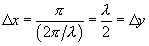
|
Therefore, for a band-limited function, the conventional sampling criterion is sufficient for the case of those measurements that are taken over non-tangential planar surfaces. If the maximum angle of coverage is less than 90 then the expressions are modified as
| (5.6) | 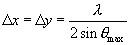
|
In one dimension, the ideal band-limited interpolation procedure required to reconstruct the continuous function from the samples taken at a set of grid points can be expressed as
| (5.7) | 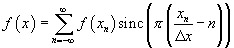
|
Here, the series is convergent and the sine function is defined as
| (5.8) | 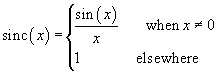
|
The value of the sine function in the limit as x tends to zero has...


 TABLE OF CONTENTS