Principles of Planar Near-Field Antenna Measurements

Truncation occurs when the angular spectrum is computed from a partial knowledge of the tangential components of the aperture field distribution or from the tangential components of the field distribution over a finite parallel plane at z = d in front of the radiator. As shown in Chapter 4, the angular spectra can be immediately obtained from the tangential electric field components using
| (5.11) | |
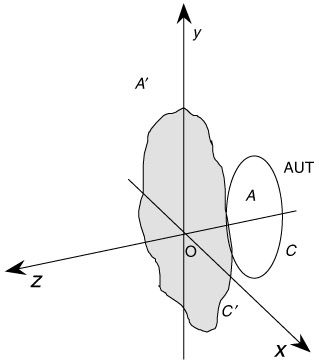
Let the region over the xy-plane in which the field is sampled be bounded by the curve C'. Furthermore, let the area outside C' that extends to infinity in all directions be denoted by A', let the aperture be bounded by the curve C and let the area of the aperture be A as illustrated in Figure 5.1.
If the field is sampled outside the aperture over a plane of finite extent, that is, bounded by the curve C', the error introduced into the angular spectra can be computed from evaluating the following integral
| (5.12) | |
The far-fields can be obtained by taking the inverse FT of this expression. This is usually accomplished by using the algorithm for the method of stationary phase and calculating the electric field components over a hemisphere of infinite radius centred about the radiator. Thus, the electric field in the far zone of the source can be expressed as
| (5.13) | |
| (5.14) | |
Conversely, the error in...