Principles of Planar Near-Field Antenna Measurements

This chapter presents a brief introduction to a number of the more advanced, and more recently developed topics associated with planar near-field antenna measurements. These include (1) active alignment correction which seeks to improve the accuracy with which the boresight direction of an antenna is known, (2) position correction techniques for improving the flatness and straightness of the sampling grid, (3) phase recovery which enables measurements to be made, where obtaining a direct phase reference would be impractical, (4) microwave holographic metrology (MHM) which is used for performing aperture diagnostics, (5) auxiliary translation and auxiliary rotation which are used to minimise truncation and (6) the poly-planar technique that is used to mitigate measurement truncation.
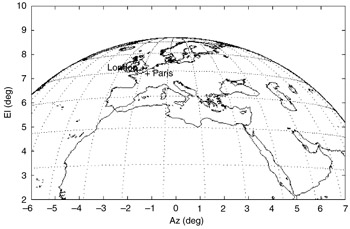
The importance of accurately determining the electrical boresight direction of an antenna with respect to a mechanical datum can be illustrated by considering the implications of an error in the pointing of a high gain space telecommunications antenna aboard a geostationary satellite. By way of illustration, Figure 9.1 contains a schematic representation of Europe and North Africa as seen from an orbit radius of 42,164.14 km, that is, an altitude of 35,786 km, a mean Earth radius of 6378.14 km with a subsatellite latitude of 0 and a subsatellite longitude of 13 .
Clearly, an error in the pointing of the antenna of as little as 1 will displace the pattern by many kilometres over the surface...