Principles of Planar Near-Field Antenna Measurements

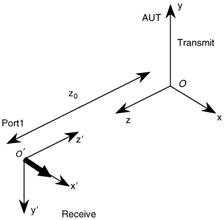
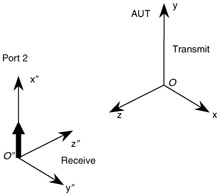
The following derivation of the transmission formula for planar near-field antenna measurement constitutes an extension of that presented by Brown [4]. Here, the theory has been extended to include two additional generalizations, cross-polarisation of transmit and receive antennas and misalignment between antennas. However, as gain is usually determined by substitution, only relative coupling coefficients are obtained as pattern normalization is avoided. Consider Figures 5.5 and 5.6.
As can be seen from the diagrams above both probes are x-polarised in their local coordinate systems. If an angular spectrum of plane waves is incident on an antenna then the complex signal received is given by an integral, over all directions, of the scalar product of the incident angular spectrum and the vector-pattern function of the antenna on transmission. Usefully, the reciprocity theorem can be used to establish that the transmitting and receiving patterns of an antenna are identical providing that within the makeup of the coupled antenna system there are no magnetised ferrites, for example, microwave isolators, and so on. This follows from observing that if the source and receiver are interchanged, the transmitted signal remains unchanged. As this must also be true irrespective of the state of the orientation between the two antennas, that is, the angle and separation, this implies that the transmitting and receiving patterns must be identical in...