Principles of Planar Near-Field Antenna Measurements

The principal assumption made within Section 5.4 was that the probes and AUT are ideally aligned. This is not the case in general. The three main alignment differences that may occur are as follows:
The AUT is not aligned with the axes of the range.
Probe 1 is not aligned with the axes of the range.
Probe 2 is not aligned with the axes of the range.
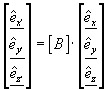
The orientation of the AUT to the range is unimportant in these considerations, as strictly, the convolution can be seen to be between the patterns of the sampled illumination function and probe. The matrix representation of the relationship between the probe B and probe C and the AUT indicate the form of a generalized antenna-antenna transmission function. Let the relationship between the axes of the transmitting antenna A and the two receiving antennas B and C be represented by
| (5.98) | |
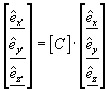
and
| (5.99) | |
where [ B] and [ C] are orthogonal and correctly normalized, that is, orthonormal, direction cosine matrices. Previously, these matrices have corresponded to a 180 rotation in elevation and a 180 rotation in elevation followed by a - 90 roll, respectively. However, in principle, they could describe any orientation in which case
| (5.100) | |
Thus
| (5.101) | |
Clearly
| (5.102) | |
Hence
| (5.103) | |
| (5.104) | |
| (5.105) | |
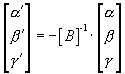
This can be expressed compactly in matrix form as
| (5.106) | |
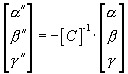
Similarly
| (5.107) | |
Although these substitutions are algebraically unwieldy, they are readily amenable for processing numerically with a...