12.1 Overview
Traditional FPGA technology advances have included consistent trends toward more logic resources, more I/O, support for more conventional I/O interface standards, higher performance, faster software design tools, lower costs and smaller packages. Many of these advances are based on leveraging each new semiconductor process node. However, in order to achieve higher growth, additional features must also be added to FPGA architectures, software and IP offerings. FPGA manufacturers continue to seek to expand the range of potential applications their products can support.
Manufacturers have identified specific application groups they want to grow in, including consumer electronics, medical, industrial, automotive and wireless communication. Each of these application groups requires a certain mix of design characteristics. These design characteristics and requirements include high volume, low power, quick time-to-market, embedded computing, signal processing and high speed signal interfaces. FPGA manufacturers have added specialized circuitry capable of supporting and implementing signal processing, embedded processing and high speed interfaces. Manufacturers and third party vendors have addressed time-to-market concerns by offering pre-implemented, pre-verified intellectual property blocks. Figure 12.1 illustrates the range and overlap of some of these specialized FPGA technology areas.
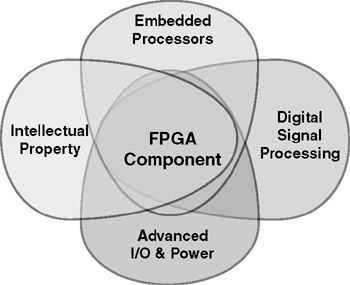 Figure 12.1: Advanced FPGA topics
 The topics of intellectual property, FPGA embedded processors, digital signal processing and advanced signal interfaces are covered in more detail in the following chapters.
As products become smaller and more portable, power consumption becomes an increasingly significant design factor. Also, as designs mature and move into volume production, there is pressure to reduce implementation cost. The issues of lower...


 TABLE OF CONTENTS