Fundamentals of Kalman Filtering: A Practical Approach, Second Edition

Containing numerous real-life problems and examples presented in detail, this text demonstrates the many ways in which Kalman filters can be designed.
 TABLE OF CONTENTS
 In the preceding chapter we saw how the method of least squares could be applied to estimating a signal based upon noisy measurements. This estimation process is also sometimes called filtering. We also observed that the least-squares technique was a batch-processing method because all of the measurements had to be taken before any estimates of the best polynomial coefficients could be made. In addition, a matrix inverse had to be evaluated as part of the required computation. The dimension of the matrix inverse was proportional to the order of the polynomial used to best fit the measurements in the least-squares sense. In this chapter we will see how the batch-processing method of least squares of Chapter 2 can be made recursive. The resulting recursive least-squares filter does not involve taking matrix inverses. Because the new least-squares filter is recursive, estimates are available as soon as measurements are taken. The simple nature of the calculations involved make recursive least-squares filtering ideal for digital computer implementation.
We have shown in the preceding chapter that if we were trying to fit a zeroth-order polynomial or constant to a set of measurement data the best estimate (i.e., minimize sum of squares of the difference between the measurement and estimate) can be expressed as
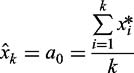
where x* i is the ith measurement and k is the number of measurements taken. In other words, we simply add up the measurements and divide by the number of measurements...