Fundamentals of Kalman Filtering: A Practical Approach, Second Edition

Containing numerous real-life problems and examples presented in detail, this text demonstrates the many ways in which Kalman filters can be designed.
 TABLE OF CONTENTS
 So far we have seen how linear Kalman filters are designed and how they perform when the real world can be described by linear differential equations expressed in state-space form and when the measurements are linear functions of the states. In most realistic problems the real world may be described by nonlinear differential equations, and the measurements may not be a function of those states. In this chapter we will introduce extended Kalman filtering for a sample problem in which the measurements are a linear function of the states, but the model of the real world is nonlinear.
To apply extended Kalman-filtering techniques, it is first necessary to describe the real world by a set of nonlinear differential equations. These equations also can be expressed in nonlinear state-space form as a set of first-order nonlinear differential equations or

where x is a vector of the system states, f ( x) is a nonlinear function of those states, and w is a random zero-mean process. The process-noise matrix describing the random process w for the preceding model is given by
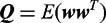
Finally, the measurement equation, required for the application of extended Kalman filtering, is considered to be a nonlinear function of the states according to

where v is a zero-mean random process described by the measurement noise matrix R, which is defined as

For systems in which the measurements are discrete, we can rewrite the nonlinear measurement equation as

The discrete...