Fundamentals of Kalman Filtering: A Practical Approach, Second Edition

Containing numerous real-life problems and examples presented in detail, this text demonstrates the many ways in which Kalman filters can be designed.
 TABLE OF CONTENTS
 In the previous chapter we saw how the batch-processing method of least-squares could be made recursive when the measurement was a polynomial signal corrupted by noise. We saw that the recursive least-squares filter provided the exact same estimates, for a given number of measurements, as the batch-processing least-squares filter. In this chapter we will first provide the general equations for the discrete Kalman filter and then show under what conditions it is completely equivalent to the recursive least-squares filter.
We also saw in the preceding chapter that if the order of the recursive least-squares filter was less than the order of the polynomial measurement signal then the filter's estimates would diverge from the true signal and its derivatives. The engineering fix was to use a higher-order filter. We will also demonstrate the divergence problem with the Kalman filter, but we will show that there are a variety of engineering fixes.
To apply Kalman-filtering theory, our model of the real world must be described by a set of differential equations. These equations must be cast in matrix or state-space form as

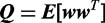
where x is a column vector with the states of the system, F the system dynamics matrix, u is a known vector, which is sometimes called the control vector, and w is a white-noise process, which is also expressed as a vector. There is a process-noise matrix Q that is related to the process-noise vector according to
We will...