Fundamentals of Kalman Filtering: A Practical Approach, Second Edition

Containing numerous real-life problems and examples presented in detail, this text demonstrates the many ways in which Kalman filters can be designed.
 TABLE OF CONTENTS
 At the beginning of this chapter, we saw that from an algebraic point of view two satellites were necessary in determining the location of a stationary receiver when only range measurements were available. We saw that when the range measurements were perfect we obtained two equations (i.e., for range) with two unknowns (i.e., downrange and altitude of receiver). The quadratic nature of the equations yielded two possible solutions, but we were able to eliminate one by using common sense. Because one satellite with one range measurement would yield one equation with two unknowns, it would appear that it would be impossible from an algebraic point of view to estimate the stationary receiver location. Let use see if this is true if we attempt to apply extended Kalman filtering to the problem.
Recall that in this problem the receiver is fixed in location, which means that the receiver velocity (i.e., derivative of position) is zero. Therefore, we can say that

If we neglect process noise, we can rewrite the preceding two scalar equations in state-space form, yielding
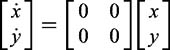
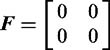
From the preceding linear state-space equation we can see that the systems dynamics matrix is zero or
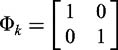
We showed in the preceding section that for a systems dynamics matrix, which is zero, the fundamental matrix was the identity matrix or
The measurement is now the range from the only satellite to the receiver. We have already shown that the true or exact range from the satellite to...