Intuitive Analog Circuit Design

This chapter builds on the device model work done in the previous chapter and models for the ideal bipolar transistor are derived. Rather than deriving the full transistor equations, we will rely on results from the ideal diode and talk through intuitively how the bipolar transistor works. The NPN transistor is considered, but results obtained are germane to analysis of the PNP transistor as well. Most of this discussion will focus on operation of the bipolar transistor in the forward-active region, the region of operation where the transistor can be used as an amplifier. In later chapters, we ll extensively discuss operation of the transistor in the saturation and cutoff regions.
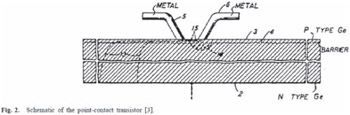
Pioneering work on the bipolar junction transistor was done at Bell Laboratories [1] in the late 1940s, with contributions from William Shockley, William Brattain, James Bardeen, and others. This team (led by Shockley) was challenged by Bell management to invent a solid-state switch to replace mechanical relays. They initially focused their efforts on devices fabricated from germanium. The first device that demonstrated the transistor effect and current gain was the point contact transistor demonstrated in 1948 [2] (Figure 4-1), which had a germanium crystal with closely spaced gold contacts on the upper surface. With this device, Bardeen and Brattain were able to demonstrate current gain.
Later on, Shockley realized that a device with two semiconductor junctions could...