Intuitive Analog Circuit Design

Emitter Switching

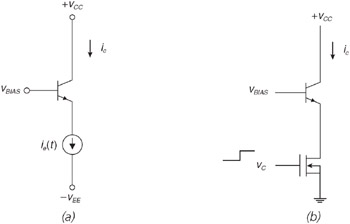
An emitter switch is shown in Figure 10-23. This type of topology has been used in power switches where high voltage isolation to the load is needed. As shown in Figure 10-23b, the MOSFET provides the high speed current switching, and the bipolar transistor is a commonbase buffer which provides voltage isolation. Note that in the emitter switching case, there is no problem with transistor saturation. Hence, we expect this type of switch to be fast. We ll estimate the switching speed of this type of topology assuming that the MOSFET provides a step of current to the emitter of the transistor.


Figure 10-23: Emitter switching. (a) Circuit. (b) Implementation as a high voltage switch with the low-side MOSFET providing the fast switching current, and the transistor providing the high-voltage buffering.

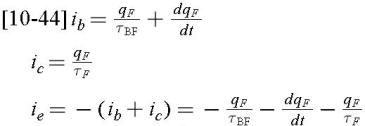
Referring to Figure 10-23a and ignoring junction capacitances, the relevant charge control equations are:


Rearranging the above emitter charge control equation results in:


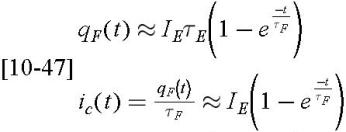
where u 1 (t) is the unit step. We can make a further approximation for the emitter charge control equation by noting that ? BF >> ? F and hence q F / ? BF << q F / ? F, resulting in:


The solution to this charge control equation is a simple exponential rise in transistor forward charge q F with characteristic time constant ? F.


This solution shows that the collector current rises with characteristic time ? F, which is comparable to 1/ ? T of...

UNLIMITED FREE
ACCESS
TO THE WORLD'S BEST IDEAS

SUBMIT
Already a GlobalSpec user? Log in.

This is embarrasing...

An error occurred while processing the form. Please try again in a few minutes.

Customize Your GlobalSpec Experience

Category: Transistors
Finish!
Privacy Policy

This is embarrasing...

An error occurred while processing the form. Please try again in a few minutes.