Intuitive Analog Circuit Design

Charge Control Model Examples

Next, we ll see how to use the charge control model by working through a number of examples.

Example 10.1: Transistor inverter with base current drive

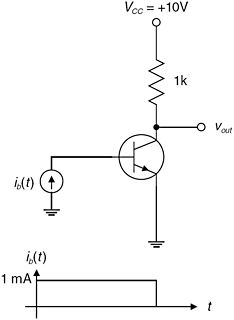
In this problem, a transistor is controlled by driving a base current as in Figure 10-10. Let s analyze the dynamics of the transistor, assuming transistor parameters: ? F = 0.3 nanoseconds, ? F = 416, ? R = 240 nanoseconds, and ? R = 0.7. We ll ignore space charge capacitances. We ll find the switching profile of this transistor circuit under these conditions. Assume that the current pulse transitions high at t = 0. Much later, after all transients have died down, the current pulse transitions back to zero.


Figure 10-10: Transistor with base current drive.

Crossing the forward-active region

Ignoring space charge capacitances, we ll find base charge q F (t) and collector current i c (t) when crossing through the forward-active region. Since we re ignoring space charge capacitances, the necessary charge control equation is relatively simple. First, recognize that when we first step the base current, the transistor will enter the forward active region. There s no turn-on delay time in this example since we have assumed that junction capacitances are negligible. After a while, the transistor will saturate, since


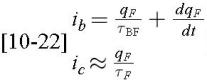
When the transistor is in the forward-active region, the charge control equations are:


Since we are driving the base with a stepped current source, the differential equation for the base current is:


where

UNLIMITED FREE
ACCESS
TO THE WORLD'S BEST IDEAS

SUBMIT
Already a GlobalSpec user? Log in.

This is embarrasing...

An error occurred while processing the form. Please try again in a few minutes.

Customize Your GlobalSpec Experience

Category: Small-Signal Bipolar Transistors (BJT)
Finish!
Privacy Policy

This is embarrasing...

An error occurred while processing the form. Please try again in a few minutes.