Intuitive Analog Circuit Design

Chapter 13: Review of Current Feedback Operational Amplifiers

In This Chapter

Current-feedback operational amplifiers are devices where the main feedback path from output to input carries a current, and not a voltage, as in voltage feedback op-amps. Current-feedback op-amps do not suffer from the gain bandwidth product paradigm as do voltage feedback operational amplifiers, and can achieve very high bandwidths. However, they do have other limitations.

Conventional Voltage-Feedback Op-Amp and the Constant Gain Bandwidth Product Paradigm

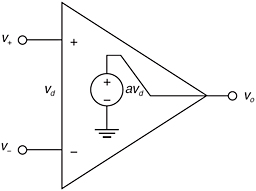
A conventional voltage-feedback operational amplifier is shown in Figure 13-1. Let s assume that the op-amp is dominated by a single pole at a very low frequency. We can express the opamp open-loop transfer function under this assumption as: [1]


where A o is the DC gain of the amplifier and 1/ ? is the pole frequency of the op-amp dominant pole. Note that we re approximating the op-amp as behaving as an integrator for frequencies of interest. This simplifies the mathematics in the following discussion considerably.


Figure 13-1: Conventional voltage-feedback op-amp. The output voltage is v o = av d = a(v + v ).

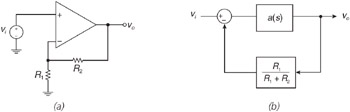
Let s put this amplifier into a positive gain configuration of Figure 13-2a. The ideal lowfrequency closed-loop gain of this amplifier is:


Figure 13-2: Conventional voltage-feedback op-amp. (a) Configured as positive gain amplifier. (b) Block diagram.

Using the block diagram of Figure 13-2b, let s figure out the overall transfer function of this amplifier:


Note that this amplifier has a low-frequency gain of G (as expected) and a bandwidth of ( K

UNLIMITED FREE
ACCESS
TO THE WORLD'S BEST IDEAS

SUBMIT
Already a GlobalSpec user? Log in.

This is embarrasing...

An error occurred while processing the form. Please try again in a few minutes.

Customize Your GlobalSpec Experience

Category: Operational Amplifiers
Finish!
Privacy Policy

This is embarrasing...

An error occurred while processing the form. Please try again in a few minutes.