Intuitive Analog Circuit Design

Chapter 7: Advanced Transistor Amplifier Techniques

In This Chapter

Various and sundry issues related to advanced amplifier design techniques are discussed.

Worst-Case Open-Circuit Time Constant Calculations

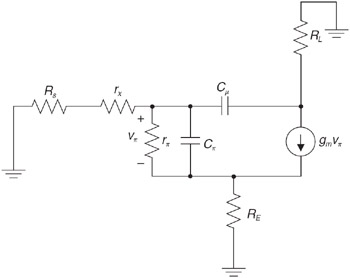
The most complicated open-circuit time constant calculation is found for a transistor amplifier that has a source resistance ( R s), emitter resistance ( R E) and collector load resistance ( R L), as shown in Figure 7-1. In the following section, we ll figure out the open-circuit resistances for C ? and C ? for this worst-case circuit.


Figure 7-1: Worstcase open-circuit time constant circuit with source resistance R s, emitter resistor R E and collector load resistor R L.

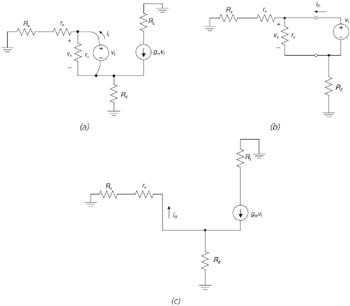
The worst-case open-circuit time constants circuit for C ? is shown in Figure 7-2a. The mathematics rapidly gets difficult if we blindly begin writing node equations. First, let s recognize that the test voltage source v t sets the value of v ?. Since the v t generator sets the value of the dependent [1] current source, we can use superposition to find the test current.


Figure 7-2: Circuits for finding worst-case OCTC for C ?. (a) Original circuit. (b) Circuit for finding contribution due to test voltage source v t only. (c) Circuit for finding contribution due to g mv t generator only.

Using the circuit of Figure 7-2b, we ll find the test current due to the test voltage source, with the g m v t dependent generator set to zero...

UNLIMITED FREE
ACCESS
TO THE WORLD'S BEST IDEAS

SUBMIT
Already a GlobalSpec user? Log in.

This is embarrasing...

An error occurred while processing the form. Please try again in a few minutes.

Customize Your GlobalSpec Experience

Category: Small-Signal Bipolar Transistors (BJT)
Finish!
Privacy Policy

This is embarrasing...

An error occurred while processing the form. Please try again in a few minutes.