Intuitive Analog Circuit Design

In this chapter, we discuss a more detailed incremental model of the bipolar transistor that takes into account the base-width modulation effect. The resulting resistive elements resulting from base-width modulation have significant design impact on high-gain amplifiers, emitter-followers and current mirrors.
The hybrid-pi model considered so far assumes that the incremental output resistance of a bipolar transistor is infinite. However, this is not the case, as anyone can attest to who has looked at transistor curves on a curve tracer. We need to consider the effects of base-width modulation to account for the fact that the output resistance seen at a transistor collector is finite.
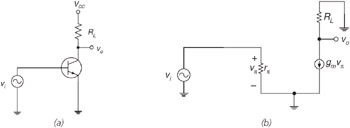
A resistively loaded common-emitter amplifier is shown in Figure 8-1. To maximize output voltage swing, we ll set the bias point of V o to V CC /2 (through means that are not explicitly shown in this schematic). This, in turn, sets the collector current and hence the transconductance of the transistor:
This results in a maximum incremental gain [1] for the resistively loaded common-emitter amplifier as:
For V CC = +12, this results in a maximum incremental gain of 230.
In order to get higher gain without arbitrarily high collector voltage, an active load (i.e., a current source) can be used. Let s first consider the ramifications of ignoring base-width modulation and the...