Saturation is the case when both base-emitter and base-collector junctions are forward biased. We can consider this mode of operation as a mixture of the forward-active and reverse-active operation, as shown in Figure 10-4.
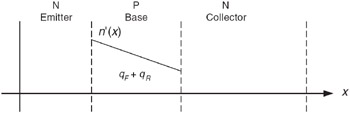 Figure 10-4: Excess carrier concentration for NPN transistor in saturation region. In saturation, both junctions are forward biased.
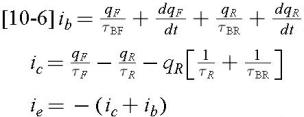
 The total charge control equations including forward-active and reverse-active operation are found by summing the previous results:
Since we ve shown that the forward active region is dominated by one time constant ( ? F) and the reverse active region is dominated by another time constant ( ? R), it makes sense that the saturation region will have two time constants, but not necessarily ? F and ? R. In fact, we ll show that the dynamics in saturation has time constants that are some weighted functions of these individual time constants.
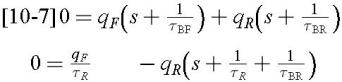
We can solve for the natural frequencies of the growth of charge in the transistor by solving the homogeneous case (and making the Laplace substitution d/dt ? s):
We can solve these simultaneous equations, resulting in:
or, simplifying: [4]
In general, there are two widely spaced poles, [3] with the fast pole being comparable to the ? T of the transistor:
The low-frequency pole is given by:
The fast time constant, sometimes called the slosh mode, corresponds to the time scale with which charge redistributes between q F and q R. The slow time constant, or the fill ...


 TABLE OF CONTENTS