Intuitive Analog Circuit Design

Development of the Switching Models

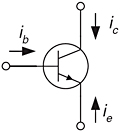
In the following development, we consider the charge control model for the NPN transistor. The results are exactly the same for a PNP transistor. Transistor terminal current definitions are given in Figure 10-1.


Figure 10-1: Terminal definitions for NPN transistor, showing base current i b, collector current i c and emitter current i e.

From device physics, we derived in an earlier chapter the fact that when a transistor is biased in the forward-active region the base-to-emitter junction is forward biased and there is extra charge stored in the base region. For an NPN transistor, the excess minority carrier concentration is shown in Figure 10-2. In the case of the NPN transistor, the base is made of P material and the excess minority carriers are electrons, and have the profile n(x) shown. There is a similar hole profile in the emitter p(x) but for purposes of analyzing switching operation we need only consider the base region.

Since transistor collector current is dominated by diffusion in the base, collector current I c is proportional to the slope of the n'(x) curve. The dotted line shows the carrier concentration profile at a higher collector current. Since the vertical axis has units of charge concentration, the total area under the curve is proportional to the charge stored in the base of the transistor. When the transistor is operated in the normal fashion and in the linear region (called the forward-active...

UNLIMITED FREE
ACCESS
TO THE WORLD'S BEST IDEAS

SUBMIT
Already a GlobalSpec user? Log in.

This is embarrasing...

An error occurred while processing the form. Please try again in a few minutes.

Customize Your GlobalSpec Experience

Category: Transistors
Finish!
Privacy Policy

This is embarrasing...

An error occurred while processing the form. Please try again in a few minutes.