Dictionary of Water and Waste Management, Second Edition
Either a natural mineral or an artificial product, but always a hydrated sodium aluminium silicate which can give up its sodium in exchange for the calcium and magnesium in water, thus reducing hardness by ion exchange. When the zeolite ceases to soften the water it is spent , but can be regenerated by passing a strong solution of sodium chloride through it. Zeolites cannot be used for turbid, acid or iron-bearing waters, and lime soda softening may be preferable for these. See clinoptilolite , ion exchange resins , regeneration.
Design of an industrial plant to release no effluent, whether cooling water (by closed recirculation system) or industrial effluent.
Movement of the zero point of an instrument in one direction, away from the correct zero, causing errors in all readings, although the difference between any two readings may be correct.
The elemental form of iron.
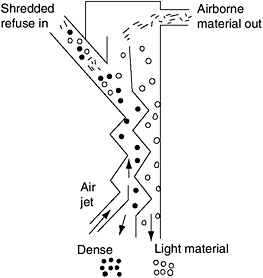
An air column separator that is either zig-zag in shape or has baffles on alternate sides of the vertical shaft ( see Figure Z.1).
This metal is commonly found in stormwater from urban areas, in part, due to the use of galvanised roofs. Zinc can be toxic to some aquatic life. It is a List 2 Dangerous Substance ( see Dangerous Substances Directive).
A number related to the contents of copper, zinc and nickel