Introduction to Optics

Including the tools and methods currently used by researchers and engineers, this book covers the essential concepts of comprehension and reports the great progress of the current knowledge in optics.
 TABLE OF CONTENTS
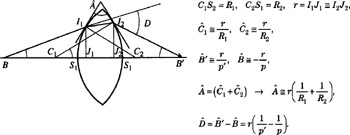
 Let C 1, C 1 S 2 = R 1, C 2, and C 2 S 1 = R 2, respectively, be the centers and the radii of curvature of the two interfaces. B and B ? are two conjugate points. We use the following notations: I 1 J 1 = I 2 J 2 = r, OB = p, and OB ? = p ?, as well as the geometric indications given in Figure 3.A.1. The lens can be considered as a prism with an angle , which would vary proportionally to the distance r to the axis. A ray is all the more deviated so that it hits the input interface at a point located farther from the axis. The angles being small, we use the law of Kepler to evaluate the deviation of the ray B 1 I 1 ?  = ( n ? 1) , we obtain