Introduction to Optics

Including the tools and methods currently used by researchers and engineers, this book covers the essential concepts of comprehension and reports the great progress of the current knowledge in optics.
 TABLE OF CONTENTS
 We will say that a problem is a two-dimensional problem if one of the geometrical coordinates, z, for example, is not involved. We also say that the problem is invariant in a translation parallel to Oz. We intend to show, in the case of an electromagnetic problem exhibiting the Oz invariance, that the set of the electromagnetic vectors is the union of two independent subsets that are called the TE and TM modes.
Introducing the six components ( E x, E y, E z, H x, H y, H z) of an electromagnetic field and the unit vectors (x, y, z) of the coordinate axis, TE and TM are defined by

Any field can be considered as the addition of a TE and TM field.
The independence versus z is simply introduced by cancelling all z derivatives, ( d/dz = 0). We write the two first Maxwell equations for harmonic waves in a vacuum:


Equations (4.A.1) and (4.A.2) are relations between vectors, and represent in fact six equations between the components of the electromagnetic field,
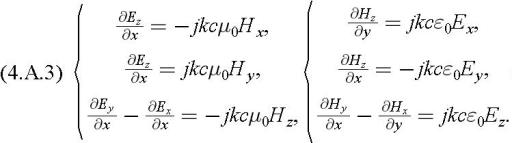
The six equations (4.A.3) may be assembled in another way:
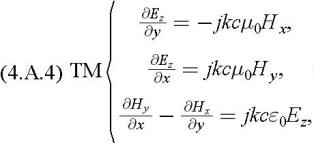
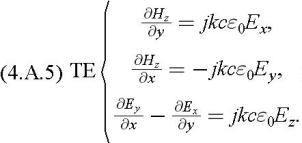
For a TE mode ( E z = 0, H x = 0, H y = 0), the three (4.A.4) equations are automatically fulfilled, as well as the (4.A.5) equations for a TM mode ( H z = 0, E