Introduction to Optics

Including the tools and methods currently used by researchers and engineers, this book covers the essential concepts of comprehension and reports the great progress of the current knowledge in optics.
 TABLE OF CONTENTS
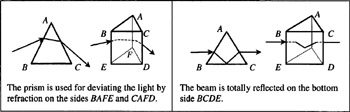
 Optical prisms are components that are commonly met in optical experimental arrangements and optical instruments; so far their main role has been to disperse the light in spectrometers, now they have been universally replaced by diffraction gratings. However, they remain very important in changing the direction of a beam, thanks either to refraction or, more often, to total internal reflection. Following the mathematical definition an optical prism is a triangular-based prism. The sides are carefully polished with a precision of the order of a small fraction of a micrometer (a good standard is ?/10 of the sodium wavelength). The precision of the angles is usually of one minute; once a prism has been polished the angles can be measured with extremely high precision (one second).
Optical prisms are very often cut from a piece of glass. For a given transparent material the knowledge of the index of refraction is very important. The more accurate method of measuring the index of refraction is to fashion a prism with the medium under consideration, and to measure the angle of deviation of a parallel monochromatic light beam. Index measurements using a refractometer are very accurate and easily give the value of refractive indices to five figures.
Demonstrations concerning the formulas that govern the propagation of light in a prism rely on rather simple geometrical considerations and will not be given here.