Introduction to Optics

Including the tools and methods currently used by researchers and engineers, this book covers the essential concepts of comprehension and reports the great progress of the current knowledge in optics.
 TABLE OF CONTENTS
 The main originality of a laser beam is to have two coherencies, spatial and temporal. Spatial coherency is synonymous with directivity, temporal coherency with monochromaticity. These two properties come directly from the stimulated emission, which produces photons in the same mode of the resonator. It's because of the properties of autooscillation that the optical characteristics (frequency and shape of the wave surfaces) of the emitted wave fit exactly with the resonator.
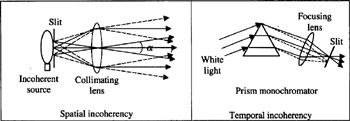
Directivity: The wave surfaces of a laser beam are perfectly defined and don't vary erratically from time to time; their shape is determined by the geometrical characteristics of the mirrors. If the output mirror is plane, the rays are orthogonal to its surface, the difference is only determined by diffraction and the angle is equal to 1.22 ?/ D ( ? is the wavelength and D the diameter of the mirror). With...