Introduction to Optics
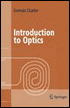
Including the tools and methods currently used by researchers and engineers, this book covers the essential concepts of comprehension and reports the great progress of the current knowledge in optics.
 TABLE OF CONTENTS
 Chapter 12 has been reviewed by Pierre Labeye, Physicist at the CEA (Commissariat l'Energie Atomique).
The capacity of a wave for transporting signals is all the more important, as the frequency is higher. What is needed if a wave is to be used as a carrier wave? First of all, coherent and powerful enough sources are necessary, then a support for the propagation of the wave is needed, with a low attenuation. Finally, one should be able to "hang to the wave" the information to be carried; in other words, to modulate the wave. Since 1960, with the appearance of lasers, coherent light sources were available. However, ten more years were necessary before it became possible to start thinking of optical telecommunications. 1970 was the important year, it was at that time that engineers became aware of the fact that silica capillary tubes made of silica SiO 2 were amazingly transparent for light waves and could thus carry light waves over very long distances, compatible with telecommunications requirements. 1970 was also the year when a laser emission was obtained from a semiconductor at room temperature.
After some time of propagation, a few kilometers in the case of radio waves propagating along metallic wires and one hundred kilometers in the case of optical fibers, the signal vanishes and must be reamplified. In 1990 a new breakthrough happened with the invention of optical amplifiers using erbium-doped silica and working at 1.55 ?m. Prior to this date the only possibility...