Introduction to Optics
Including the tools and methods currently used by researchers and engineers, this book covers the essential concepts of comprehension and reports the great progress of the current knowledge in optics.
 TABLE OF CONTENTS
 The demonstration of this formula requires a rather sophisticated knowledge of mathematics and, more specifically, about Riemann and Cauchy integrals. A presentation can be found in the book Solid State Physics by C. Kittel, here we will just emphasize the physical articulations of the demonstration. By the way, we would like to underline the specific beauty of the argument which put the Principle of Causality on a mathematical basis and which also establishes a well-known experimental result, according to which blue light is more deviated than red light by a prism.
Let P be the polarization taken by a piece of material when submitted to an electric field E. If the field varies with time, so does the polarization. A sine variation of the field will create a sine variation of the polarization. The complex vector P is proportional to E: the field plays the role of an excitation, the polarization being the response,

If the excitation is no longer sinusoidal, but follows some other law of variation versus time, the situation is more complicated and the Fourier transform method should be used. We will now consider the case where the excitation is a Dirac pulse,
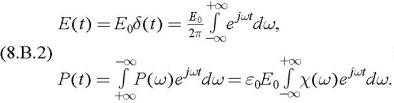
Formula (8.B.2) is a well-known result; the harmonic susceptibility ?( ?) (ratio response/excitation in the harmonic case), is the inverse Fourier transform of the time response to a Dirac pulse,

Since the response cannot exist prior to excitation, P( t