Introduction to Optics

Including the tools and methods currently used by researchers and engineers, this book covers the essential concepts of comprehension and reports the great progress of the current knowledge in optics.
 TABLE OF CONTENTS
 When some incident beam hits the interface separating two transparent media, it may happen that two transmitted beams are generated; when this is the case, at least one of the two media is anisotropic. This phenomenon was first observed in 1669 by the Dane Erasmus Bartholimus who called it double refraction. Media in which double refraction occurs are said to be birefringent. As early as 1690, using his famous construction of refracted beams, Huygens could give an interpretation of the principal aspects of birefringence.
When crossing an anisotropic material limited by two planar interfaces, a parallel beam of natural (unpolarized) light generates two transmitted beams, they are linearly polarized along two mutually orthogonal directions which are labeled (1) and (2) in Figures 5.1 and 5.2, and which are determined by the orientation of the material.
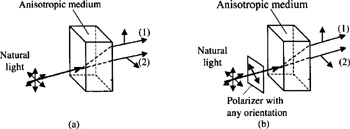
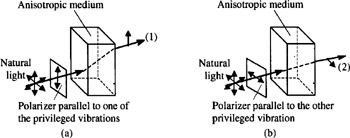
When the two sides of the anisotropic sample are planar and parallel, the two emerging beams are parallel to the incident beam. In the...