Introduction to Optics
Including the tools and methods currently used by researchers and engineers, this book covers the essential concepts of comprehension and reports the great progress of the current knowledge in optics.
 TABLE OF CONTENTS
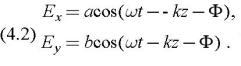
 Light vibration is a vibrating vector. The oscillating aspect of light can be expected after some observation, its subtler vector character remains to be discovered. If the study of Optics is started from Maxwell's equations, the optical vibration is immediately introduced as a vector. The direction of the vector may be along any direction of the wave plane and is determined by the light source. x and y being two orthogonal unit vectors of the wave plane, and Oz being the direction of propagation, the light vibration and its two components can be written as

Using a suitable change of the time origin, (4.2) can be written
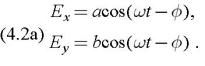
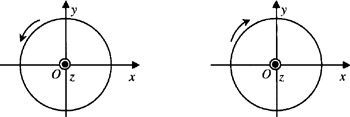
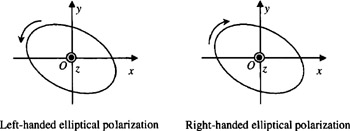
Figure 4.1 indicates that, as times progresses, the endpoint of vector E describes an ellipse, this is the reason why it is said that the more general polarization is elliptical. According to the phase difference between E x and E y, the ellipse will take different aspects and will be described clockwise or anticlockwise.
Chapter 4 has been reviewed by Dr. Fran ois M ot, Senior Physicist at the CEA (Commissariat l'Energie Atomique).