Introduction to Optics
Including the tools and methods currently used by researchers and engineers, this book covers the essential concepts of comprehension and reports the great progress of the current knowledge in optics.
 TABLE OF CONTENTS
 Fourier analysis is a good example of a mathematical tool that has been exhibited by physicists and for which mathematicians have developed a very powerful and elegant theory, for the highest mutual benefit. We will consider Fourier analysis as a useful tool and will not raise any problem about the definition of real or complex functions or about their expression by means of Fourier integrals. For the reader who is familiar with this theory we hope that it will be an opportunity of a new visit, and that it will help others to become familiar with it.
A periodic function f(t), of angular frequency ?, can always be considered as the sum of harmonic functions whose frequencies are multiples of ?, which is called the fundamental frequency. Using obvious notations we write
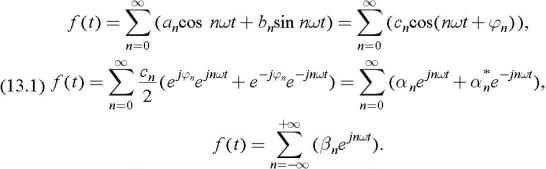
Formula (13.1) is the Fourier series representation of the periodic function f(t), it's also called the Fourier development of f(t). It is strictly equivalent to know f(t) or to know the set of complex numbers { ? n}.
The variable t will always be considered as real. If the function f(t) is also real we have ? n = ?* ?n.
For more general functions f(t), i.e., nonperiodic functions, Fourier series are replaced by Fourier integrals. The function f(t) is then the sum of infinity of sinusoidal functions, as indicated by...