Approximate Boundary Conditions in Electromagnetics

Chapter 4: Application to Impedance Wedges

4.1 Introduction

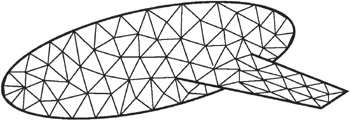
The half-plane which was the subject of the preceding chapter is the special case of a wedge whose interior angle is zero, but for a complex target such as an aircraft (see Fig. 4-1), a high frequency simulation requires the knowl-

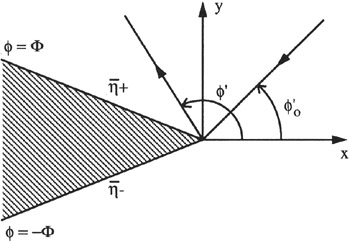
edge of the diffraction coefficient for a wedge of arbitrary angle. Indeed, the diffraction coefficient for a perfectly conducting wedge is at the heart of such well-known techniques as the uniform geometrical theory of diffraction (UTD) (Kouyoumjian and Pathak, 1974; Hansen, 1981; Knott et al., 1985; Mcnamara et al., 1990; Pathak, 1992) and the physical theory of diffraction (PTD) (Ufimtsev, 1971; Mitzner, 1974; Lee, 1990), and to extend these to impedance surfaces, it is essential to consider diffraction by the impedance wedge illustrated in Fig. 4-2.


Figure 4-1: Faceting of an airframe geometry. The junctions between facets are treated as wedges in simulating radar scattering or on-board antenna radiation

Figure 4-2: Wedge geometry and the coordinate system for Maliuzhinets' method

For a plane wave incident in a plane perpendicular to the edge (referred to as normal incidence), a method valid for arbitrary (constant) face impedances was developed by Maliuzhinets (1951, 1958b) and bears his name. The method involves the solution of a first order functional difference equation for a spectral function, and is described in the next section. A uniform expression for the diffraction coefficient (Tiberio et al., 1985; Herman and Volakis, 1988) is then presented. Unfortunately, the more general case of skew incidence is much...

UNLIMITED FREE
ACCESS
TO THE WORLD'S BEST IDEAS

SUBMIT
Already a GlobalSpec user? Log in.

This is embarrasing...

An error occurred while processing the form. Please try again in a few minutes.

Customize Your GlobalSpec Experience

Category: Diffraction Gratings
Finish!
Privacy Policy

This is embarrasing...

An error occurred while processing the form. Please try again in a few minutes.