Approximate Boundary Conditions in Electromagnetics

By increasing the order of the boundary condition it is possible to improve the accuracy with which the surface properties are simulated, but the penalty is an increase in the complication of an analytical or numerical solution of the problem. Nevertheless, there are some instances where this is worthwhile and, since the task can be simplified somewhat by choosing appropriately the form of these higher order conditions, we address this matter first.
It is convenient to start by considering the boundary conditions on a scalar field U( x, y, z) at a planar surface y = 0, where U represents, for example, an acoustic velocity potential or the normal component E y (or H y) of an electromagnetic field with H y (or E y) zero everywhere.
A general linear Mth order boundary condition is
| (6.1) | ![]() |
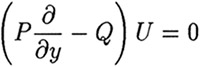
and if the wave equation is used to eliminate all even derivatives with respect to y, we obtain
| (6.2) | ![]() |
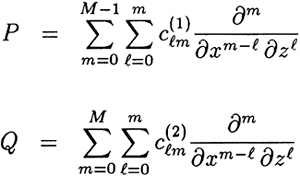
with
| (6.3) | ![]() |
where the coefficients
can be expressed in terms of the c k ?m. Let us now examine the forms taken by the differential operators in special cases. If the surface is invariant under a 180-degree rotation about the y axis, the transformation x, z ? - x, - z shows
Invariance under a 90-degree rotation produces the additional restrictions
etc., with similar conditions on the
; and finally, for invariance...