Approximate Boundary Conditions in Electromagnetics

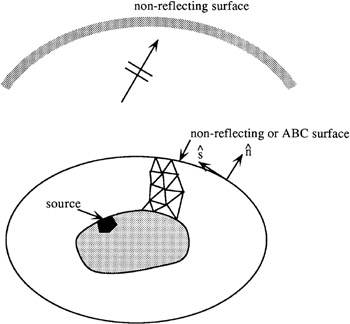
The GIBCs discussed in the preceding chapters were designed to simulate the surface properties of a scatterer, thereby eliminating the need to consider fields interior to the body. There is, however, another purpose for approximate boundary conditions, and this is to create a boundary which does not perturb a field incident upon it in effect, to simulate a surface which is actually not there. The resulting conditions can be regarded as GIBCs for non-reflecting surfaces, and are generally referred to as absorbing boundary conditions (ABCs). They are of growing importance in numerical work where they are used to terminate the computational domain in a finite element (Silvester and Ferrari, 1990) or finite difference (Kunz and Luebbers, 1993) solution of the wave equation (see Fig. 8-1). In considering their two- and three-dimensional forms, emphasis will be placed on second order ABCs because of their extensive use in scattering and radiation problems.
Two general methods for deriving ABCs have been described in the literature, along with a number of variations of each. Regardless of the method, the goal is to construct a local differential operator which minimises the reflection coefficient for any wave impinging on the surface where the ABC is applied. After a survey of the various methods, we then present a third one based on Rytov's derivation of a GIBC described in Appendix A. In this case the general form of a second...