Approximate Boundary Conditions in Electromagnetics

One of the first rigorous derivations of an approximate boundary condition was by Rytov (1940), who developed conditions through the second order applicable at the curved surface of a highly conducting body. The results are important in showing the effect of surface curvature and material variations, and we will now apply the same method to the formulation used by Leontovich (1948). The boundary conditions obtained (Senior, 1990) are more general than those given by either author, and reveal some errors in the expressions quoted by Leontovich.
A lossy body composed of a material whose complex permittivity ? and complex permeability ? may vary as functions of position is immersed in free space and illuminated by an electromagnetic field. On the assumption that the external field varies slowly over the surface S, we seek a boundary condition that can be applied at S to simulate the effect of the material.
Inside the body Maxwell's equations are
? x E' = - j ??H', ? x H' = j ??E'
where the prime denotes the interior field. Since
we have
| (A.1) | |
where
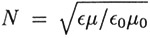
is the complex refractive index of the material, and similarly
| (A.2) | |
Assume N is large everywhere inside the body, and on this basis write
| (A.3) | ![]() |
where ? is a function of position and q is a small parameter. With geometrical optics as a guide, let
Then
with a similar equation for ? x...