Approximate Boundary Conditions in Electromagnetics

Chapter 7: GIBC Applications to Cylindrical Bodies

The GIBC applications discussed so far have been to planar surfaces but, as evident from the general forms presented in the last chapter, the conditions are also applicable to curved surfaces. To illustrate this fact, we now consider their application to the singly curved surface of a cylinder. In the special case of a homogeneous circular cylinder, the exact solution of the scattering problem is known, and this can be used to construct approximate boundary conditions as well as to determine their accuracy. An important practical application is to coated metallic cylinders. This is examined in the second section, where we demonstrate the accuracy that can be achieved with a second order GIBC, and we then develop a high frequency solution.

7.1 Homogeneous Circular Cylinder

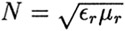
We consider a right circular cylinder composed of a homogeneous dielectric of complex refractive index .

7.1.1 Exact Eigenfunction Solution

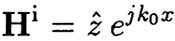
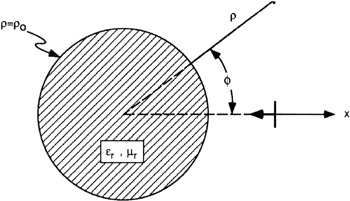
In terms of the cylindrical polar coordinates ?, ?, z the cylinder is defined as ? = ? 0 and is illuminated by the H-polarised plane wave

(7.1)

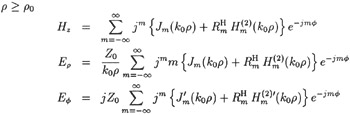
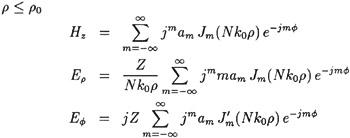
incident in a plane perpendicular to the z axis of the cylinder as shown in Fig. 7-1. The only non-zero components of the total field are then H z, E ? and E ? , and they can be expressed as follows:


Figure 7-1: Geometry for the homogeneous circular cylinder
(7.2)
(7.3)

where Z is the intrinsic impedance of the dielectric, J m is the...

UNLIMITED FREE
ACCESS
TO THE WORLD'S BEST IDEAS

SUBMIT
Already a GlobalSpec user? Log in.

This is embarrasing...

An error occurred while processing the form. Please try again in a few minutes.

Customize Your GlobalSpec Experience

Category: Hydraulic Cylinders
Finish!
Privacy Policy

This is embarrasing...

An error occurred while processing the form. Please try again in a few minutes.