Approximate Boundary Conditions in Electromagnetics

A crucial step in the solution of Wiener-Hopf or dual integral equations is the factorisation (or splitting) of an even function F( ?) into a product of two functions such that
| (B.1) | |
where ? = ? + j ?, F +( ?) is free of singularities and zeros in the upper ( ? > ? -) half of the complex ?-plane, and F_( ?) has similar properties in the lower half ? > ? +, with ? + > ? -. For the factorisation to be possible, F( ?) must be analytic in the strip ? - < ? < ? + where ? may be vanishingly small. If we further demand that F( ?) ? 1 uniformly as ? ? ? in the strip, then (Mittra and Lee, 1971)
| (B.2) | |
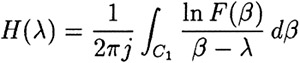
where
| (B.3) | ![]() |
and C 1 is the path shown in Fig. B-1. The last of the above conditions is not a restriction since we can always modify F( ?) to produce this behaviour. In addition, because F( ?) is an even function, we can set ? - = - ? +, ensuring that the path C 1 (for which ? = 0) remains within the strip as ? + approaches zero. The integral (B.3) is not convenient...