Approximate Boundary Conditions in Electromagnetics

An integral which is important in diffraction theory is
| (C.1) | ![]() |
where ? is a positive real quantity, C is some contour in the complex ? = ?+ j ? plane, and
f( ?) = u( ?, ?) + jv( ?, ?)
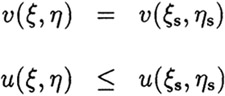
is an analytic function with non-zero imaginary part. Since ? is typically large, the exponential portion of the integrand is highly oscillatory and, to facilitate the evaluation of the integral, C is deformed into the path C SDP shown in Fig. C-1. The new path is such that on C SDP
| (C.2) | ![]() |
where ? s = ?s+ j ? s is a point still to be determined and, because v is constant, the integrand is no longer oscillatory. From Cauchy's residue theorem we then have
| (C.3) | |
where the residues are those of any poles which are captured, and I b( ?) is the contribution from any branch cuts crossed in the deformation of C into C SDP We will henceforth omit I b( ?). The remaining integral in (C.3) is
| (C.4) | |
and in view of (C.2)
| (C.5) | |
Since ? is clearly real, (C.4) can be written as
| (C.6) | ![]() |
and for ? ? 1 the exponential decreases rapidly away from ? = 0. The only significant contribution to the integral is from the immediate vicinity of ? s, and we...