Overview
The physical optics (PO) currents are discontinuous at any edge or other line discontinuity in the surface slope, and, since they are non-zero only over the illuminated portion of a body, they may also be discontinuous at a shadow boundary. The discontinuity at an edge yields the PO diffracted field. This is part of the "true" edge-diffracted field, but the PTD formulation (see Section 4.4) requires that we separate it out. As an example, for the metallic half-plane in Fig. 3-11, the PO diffracted field is
| (D.1) | 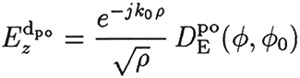 |
with
| (D.2) |  |
In accordance with PTD, the fringe wave field is then
| (D.3) | 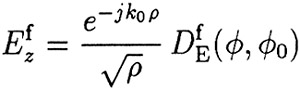 |
where
| (D.4) |  |
and
| (D.5) |  |
obtained from (3.46) by putting ? = 0. In contrast to (D.2) and (D.5) which are infinite at ? = ? ? 0, the fringe wave diffraction coefficient (D.4) is continuous there.
We now derive the PO diffraction coefficient for an impedance wedge illuminated by the plane wave at skew incidence. The incident field is written as
| (D.6) |  |
where . = 0, =  and the direction of incidence is
| (D.7) |  |
The angles ? 0 and ? i are shown in Fig. D-1, with ? 0 measured from the upper
(+) face of the wedge and, in the special case of normal incidence, ? i = ?/2. In carrying out the analysis, it is convenient to work with the z components of and  , and from...


 TABLE OF CONTENTS