Approximate Boundary Conditions in Electromagnetics

Although a second order GIBC is a relatively simple extension of an SIBC, the mathematical differences are significant, and it is more difficult to establish the conditions under which the boundary value problem has a unique solution. For this reason, it is convenient to treat first a scalar boundary condition.
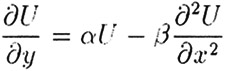
A special case of (5.7) and (5.8) is that in which E y and H y are independent of z corresponding to a two-dimensional field, and we start by considering the boundary condition
| (5.68) | ![]() |
where ? and ? are constants. The condition is applied at the planar surface y = 0+ and we seek the scalar field U in y ? 0 where U satisfies the two-dimensional scalar wave equation.
Following the procedure used in Section 2.7, we postulate two solutions generated by the same sources in y > 0. If W is the difference solution and k 0 has a small negative imaginary part, (2.139) becomes
and, since W also satisfies (5.68), insertion into the left hand side and a subsequent integration by parts gives
| (5.69) | |
Because the right hand side is never positive and is zero only if W = 0 in y ? 0, a sufficient condition for a unique solution in the case of a passive surface is
| (5.70) | |
A generalisation is to allow ? and/or ? to be discontinuous at (say)